Free · Preset for patios
Pea Gravel Patio Calculator
Preset to a 12 by 12 foot patio at 3 inches deep. Change any figure to match your own layout, and read the sections below before you order, because a patio fails differently from a garden bed.
Quantity
How much pea gravel do you need for a patio?
Multiply the length by the width, multiply by 3 inches of depth, then add 10 percent so you are not short. At that depth one cubic yard covers 108 square feet and one US ton covers about 80 square feet.
The figures below are the pea gravel surface only, with the 10 percent allowance already included. The crushed stone base underneath is a separate order of a similar size.
| Patio size | Area | Cubic yards | US tons | 0.5 ft³ bags |
|---|---|---|---|---|
| Small | 10 x 10 ft, 100 ft² | 1.02 | 1.38 | 55 |
| Typical | 12 x 12 ft, 144 ft² | 1.47 | 1.98 | 79 |
| Dining set | 12 x 16 ft, 192 ft² | 1.96 | 2.64 | 106 |
| Large | 16 x 20 ft, 320 ft² | 3.26 | 4.40 | 176 |
| Extra large | 20 x 20 ft, 400 ft² | 4.07 | 5.50 | 220 |
A 12 by 12 foot patio is 79 bags, roughly 4,000 lb lifted twice. Bulk delivery costs about a quarter as much and arrives in one pile. The bulk versus bagged comparison has the crossover maths.
Depth
How deep should a pea gravel patio be?
Three inches over a compacted base of 2 to 3 inches. Excavate about 6 inches below your finished grade so the patio sits flush with the lawn rather than standing proud of it.
Two inches is too shallow. The base grins through within a season and you see grey crushed stone in the gaps. Four inches or more is worse in a different way, because loose rounded stone gets softer underfoot the deeper it goes, and furniture sinks further into it.
| Layer | Depth | Material |
|---|---|---|
| Surface | 3 in | Pea gravel |
| Base | 2 to 3 in | Compacted crushed stone |
| Separation | One layer | Woven geotextile fabric |
| Subgrade | Graded | Native soil, sloped to drain |
| Total excavation | About 6 in | Below finished grade |
A patio carries far less load than a gravel driveway, which needs 4 to 6 inches of base under 4 to 6 inches of gravel. Chairs and a table are not a car. The base is still not optional, it is just thinner.
The part nobody warns you about
Patio furniture sinks into pea gravel
This is the single most common regret with a pea gravel patio and almost no guide mentions it. Loose rounded stone offers no resistance to a point load, so chair legs sink, tables sit unevenly, and chairs tip when someone leans back. A slim heel disappears into it entirely.
Three fixes, in order of how well they work.
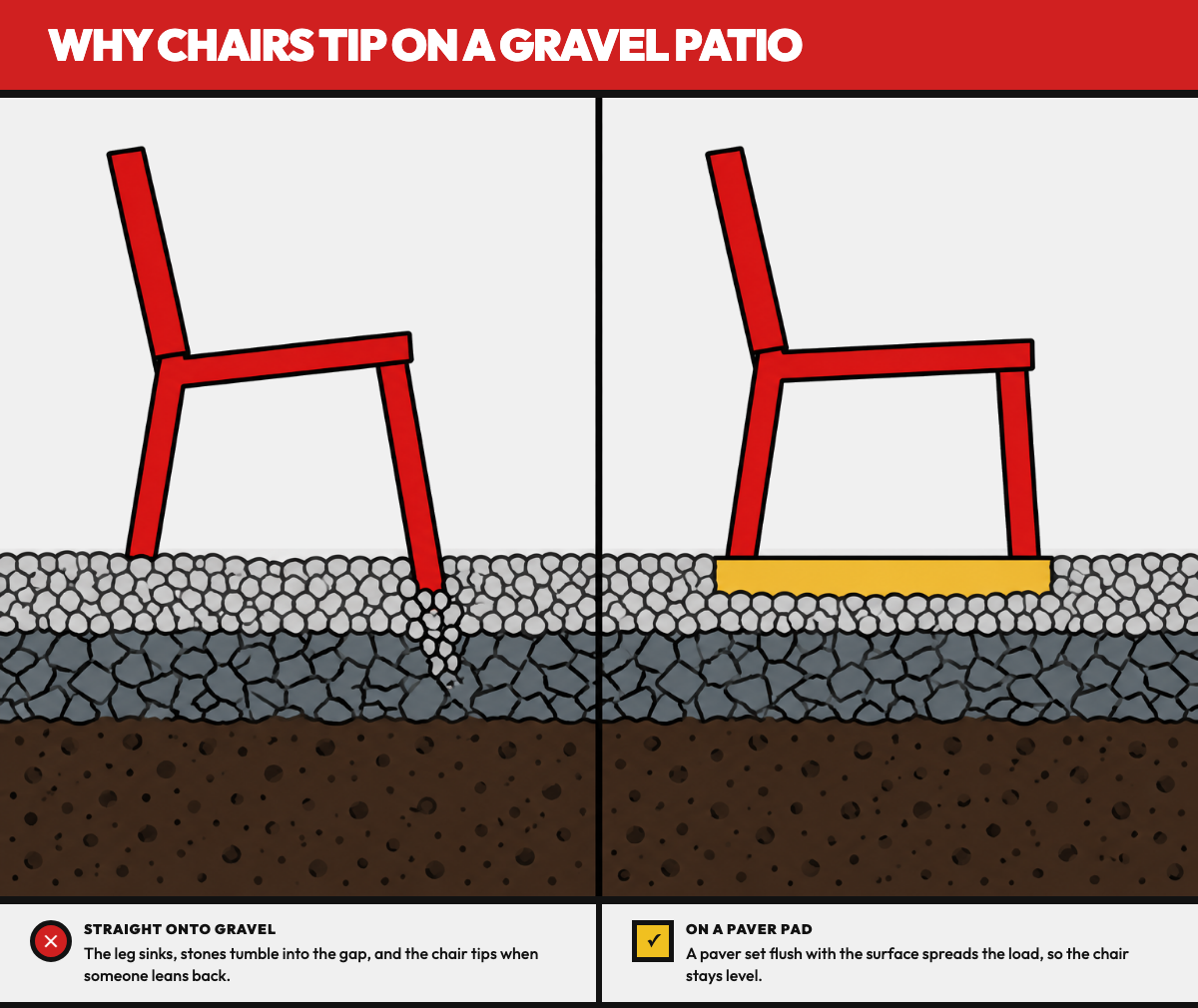
Paver pads under the legs
Set a 12 inch paver flush with the gravel under each furniture leg. Cheapest fix, works immediately, and looks deliberate if you match the stone color.
A flagstone island
Lay a solid area of flagstone or pavers where the dining set lives, and keep pea gravel for the surrounding walkable space. The most durable answer and the one most people arrive at eventually.
A stabilising grid
Plastic honeycomb panels laid on the base and filled with gravel. The stone stays put and the surface stops shifting. More work up front, best result across the whole patio.
Whichever you choose, decide before you order. Retrofitting pads means lifting gravel, setting the pavers on the base, and raking everything back.
Groundwork
What goes under a pea gravel patio?
Three layers, in this order, and skipping any of them shows up within a year.
- Graded soil. Slope it about a quarter inch per foot away from the house so water leaves rather than pools.
- Woven geotextile fabric. Stops the base sinking into soft ground and slows weeds. Overlap seams by 12 inches. This is not thin weed membrane, and it is a separation layer rather than weed control.
- Compacted crushed stone, 2 to 3 inches. Angular stone with fines, compacted in shallow lifts. This is what makes the patio feel firm.
The base is also the reason a patio stays level. Pea gravel cannot hold a shape on its own because the stones roll. Everything underneath is doing the work. Our material guide shows what each base grade looks like, and the main calculator will work out base quantities if you switch the material to crushed stone.
| Patio size | Cubic yards of base | US tons |
|---|---|---|
| 10 x 10 ft | 1.06 | 1.49 |
| 12 x 12 ft | 1.53 | 2.15 |
| 16 x 20 ft | 3.41 | 4.78 |
Living with it
What a pea gravel patio is like to use
Underfoot
Comfortable barefoot, which is the main reason people pick it over crushed stone. The stones are tumbled smooth rather than fractured. It is still loose, so it is poor for high heels, wheelchairs and strollers.
Drainage
Excellent, and the strongest practical argument for it. Rain goes straight through instead of standing, so there are no puddles and no runoff to manage. This is why it suits shady corners and low spots.
Weeds
Fabric stops weeds coming up from below, but seed lands on top and roots in the dust that collects between stones. Pull them small. Once roots reach the base layer it becomes a job.
Upkeep
Rake it level a couple of times a year and pull stone back from the edges. Expect to top up every few years as gravel works into the base and gets carried away on shoes. Roughly one cubic yard per 108 square feet restores an inch.
Cost
What does a pea gravel patio cost?
Material is cheap. A 12 by 12 foot patio needs about 2 tons of pea gravel, which is roughly $100 at $50 per ton delivered, plus delivery at roughly $10 to $25 per ton and a similar volume of base stone. Call it $250 to $350 in materials for a typical patio.
The same gravel in bags is 79 bags at $4 to $8 each, so $320 to $630 for the surface alone, before the base. That is the entire argument for bulk delivery on a patio-sized job. The cost calculator runs this comparison for any size.
Labour is what moves the total. Excavating 6 inches across 144 square feet is about 2.7 cubic yards of soil to remove, and that is a day of work before any gravel arrives.
Honest limits
When a pea gravel patio is the wrong choice
A formal dining area
Chairs move constantly and legs sink. Use pavers or flagstone where the table sits, gravel around it.
Wheelchair or stroller access
Loose gravel is not a firm stable surface. Decomposed granite compacts hard and is the usual answer.
Directly outside a door
Stones travel indoors on shoes. Keep a hard threshold or a band of paving between the patio and any doorway.
Any real slope
Rounded stone migrates downhill. Above roughly 5 percent it ends up at the bottom of the garden.
Questions
Pea gravel patio FAQ
A 12 by 12 foot patio at 3 inches deep needs about 1.47 cubic yards, or 1.98 US tons, with a 10 percent waste allowance included. One cubic yard covers 108 square feet at that depth, and one ton covers about 80 square feet.
Three inches of pea gravel over 2 to 3 inches of compacted crushed stone. Two inches is too shallow and the base shows through. Four inches or more feels loose underfoot and furniture sinks further.
Yes. Chair and table legs sink into loose rounded stone, and chairs tip when someone leans back. The usual fixes are paver pads set flush under each furniture leg, a flagstone insert under the dining set, or a plastic gravel stabilising grid beneath the whole seating area.
Yes. Lay woven geotextile fabric on the graded soil, then 2 to 3 inches of compacted crushed stone, then the pea gravel. Without it the stone works down into the soil and the patio loses depth and develops soft spots within a season.
More comfortable than crushed stone, because pea gravel is rounded and tumbled rather than sharp. It is still loose underfoot, so it is poor for high heels, wheelchairs and strollers. Decomposed granite compacts firm and is the usual alternative when firmness matters.
Woven geotextile fabric under the base stops weeds growing up through it, but seed still lands on top and germinates in the dust that collects between stones. Pull weeds while they are small, before roots reach the base layer.
Material for a 12 by 12 foot patio is roughly 100 dollars in bulk pea gravel at 50 dollars per ton, plus a delivery fee and the crushed stone base. The same quantity bought in bags is about 79 bags and several times the price.
Transparency
Sources and methodology
- Pea gravel density, 100 lb/ft³, 1.35 US tons per cubic yard. Mid-range bulk density for rounded water-worn gravel in the 3/8 inch size class. Background on aggregate production and classification, USGS Mineral Commodity Summaries 2026, Sand and Gravel (Construction) (PDF).
- Waste allowance, 10 percent. Patios are walked on rather than driven on, so they settle less than a driveway, which uses 25 percent.
- Base compaction, 15 percent. Dense graded stone loses volume when rolled, so order loose volume.
- Pricing. Indicative US ranges for comparison only. Aggregate and labour pricing is intensely local. Confirm with your own supplier.
Working on something else?
The main calculator covers beds, paths, circles, L-shapes and seven materials.